CANADA
1. ENERGY, ECONOMIC AND ELECTRICITY INFORMATION
1.1 General Overview
Canada, occupying about 10 million km2 and having a population of over 30 million
(Table 1), is one of the least densely populated countries in the world. Canada's
birth rate, at present, is 12 per 1,000 whereas death rate is seven per 1,000
with the result that the rate of natural population increase now stands at five
per 1,000 persons. Canada has strong seasonal changes and large regional variations
in temperature. The rigorous climate, the energy intensive nature of the country's
industries, and the large distances between population centres produce a high
per capita energy use.
TABLE 1. POPULATION INFORMATION
|
|
|
|
|
|
|
|
|
Growth |
|
|
|
|
|
|
|
|
|
rate (%) |
|
|
|
|
|
|
|
|
|
1990 |
|
|
|
1970 |
1980 |
1990 |
2000 |
2001 |
2002 |
To |
|
|
|
|
|
|
|
|
|
2002 |
|
|
|
|
|
|
|
|
|
|
|
Population (millions) |
|
21.3 |
24.6 |
27.8 |
30.8 |
31.0 |
31.3 |
1.0 |
|
Population density (inhabitants/km²) |
2.1 |
2.5 |
2.8 |
3.1 |
3.1 |
3.1 |
|
|
|
|
|
|
|
|
|
|
|
|
|
|
|
|
|
|
|
|
|
|
|
Predicted population growth (%) 2002 to 2010 |
|
6.3 |
|
|
|
|
||
|
Area (1000 km²) |
|
|
|
9976.1 |
|
|
|
|
|
Urban population in 2002 as percent of total |
|
79.1 |
|
|
|
|
||
Source: IAEA Energy and Economic Database.
1.1.1. Economic Indicators
Table 2 gives the statistical Gross Domestic Product (GDP) data and the GDP by sector.
TABLE 2. GROSS DOMESTIC PRODUCT (GDP)
|
|
|
|
|
|
|
|
|
Growth |
|
|
|
|
|
|
|
|
|
rate (%) |
|
|
|
|
|
|
|
|
|
1990 |
|
|
|
|
1980 |
1990 |
2000 |
2001 |
2002 |
To |
|
|
|
|
|
|
|
|
|
2002 |
|
GDP (millions of current US$) |
|
266,002 |
572,676 |
700,572 |
732,798 |
772,369 |
2.5 |
|
|
GDP (millions of constant 1990 US$) |
|
434,402 |
572,676 |
751,934 |
777,500 |
798,492 |
2.8 |
|
|
GDP per capita (current US$/capita) |
|
10,816 |
20,607 |
22,768 |
23,620 |
24,699 |
1.5 |
|
Source: IAEA Energy and Economic Database.
1.1.2. Energy Situation
The energy sector is an important part of Canada's economy. The energy sector employs just under 300,000 Canadians (or about 1.8 per cent of the Canadian labour force) and accounts for about 6.2 per cent of Canada's GDP. However, there are marked regional differences in energy production and consumption. The Canadian energy sector enjoys a strong presence in all primary energy commodities and strong electricity and energy efficiency industries. Canada has more lakes and rivers than any other country in the world. Electricity accounts for about 15 per cent of domestic energy requirements. Canada's total hydropower potential is estimated at approximately 600 TWh. Canada is also well endowed with oil, natural gas, coal and uranium. Canada produces a surplus of crude oil above its domestic needs. In 2002, remaining established reserves of conventional crude oil amounted to 4.3 billion barrels. Proven reserves of natural gas were 1.7 trillion m3, about three per cent of global reserves. Canada has extensive coal reserves estimated at 6,578 million metric tonnes representing about one per cent of the world's coal resources. They represent about 90 times the 2002 Canadian production. Alberta, British Columbia and Saskatchewan account for over 95 per cent of total output. Close to half of Canada's coal production is exported. Canada produces a wide range of metals and minerals and is the world's leading producer of uranium. As of January 1st 2003, its proven uranium deposits amount to 288,000 metric tonnes. Table 3 shows the energy resources in exajoules.
Canada has been a net exporter of most energy forms since 1969. In 2002, Canadian energy exports were valued at $Cdn50 billion. The United States is by far Canada's largest customer (over 90% of Canada's energy exports). Virtually all of Canada's exports of oil, natural gas and electricity and 41 per cent of uranium exports go to the US. The energy statistics are given in Table 4.
TABLE 3. ESTIMATED ENERGY RESERVES
|
|
Estimated energy reserves in |
|||||
|
|
(Exajoule) |
|||||
|
|
|
|
|
|
|
|
|
|
Solid |
Liquid |
Gas |
Uranium |
Hydro |
Total |
|
|
|
|
|
(1) |
(2) |
|
|
|
|
|
|
|
|
|
|
Total amount in place |
174.21 |
33.15 |
64.29 |
178.21 |
124.26 |
574.12 |
|
|
|
|
|
|
|
|
|
(1)
This total represents essentially recoverable reserves. |
|
|
|
|
||
|
(2)
For comparison purposes a rough attempt is made to convert hydro capacity
to energy by multiplying |
||||||
|
the gross theoretical annual capability
(World Energy Council - 2002) by a factor of 10. |
|
|||||
Source: IAEA Energy and Economic Database.
1.2. Energy Policy
Canada's energy policy supports a variety of energy sources, including nuclear energy, in order to ensure a secure and "sustainable" energy future for Canadians. There are three major areas of active federal energy policy development: conventional and renewable energies, nuclear energy and environment.
The federal government's approach to energy policy has gradually evolved over the last two decades to a stronger market-driven and less interventionist approach to energy development. In recent years environmental pressures are shaping the energy policy agenda. Environmental protection, energy efficiency and the development of new alternative sources of energy remain high on the list of federal objectives for the energy sector. The focus now is on achieving a balance between economic, environmental and security objectives, i.e., sustainable development. In December 2002, Canada ratified the Kyoto Protocol reaffirming its commitment to work with the international community to address this global problem. Meeting Kyoto targets is high on the federal government agenda.
With respect to nuclear energy, the federal government is supportive of the nuclear energy option for Canada and views nuclear energy as an important component of a diversified energy mix. The federal government provides funding for Atomic Energy of Canada Limited's (AECL) nuclear R&D programme. The federal government also regulates the development and application of nuclear energy in Canada. Decision-making responsibility for planning, construction and operation of nuclear plants reside with the provinces and provincial electric power utilities. There are currently no firm plans to build additional nuclear plants in Canada although there is growing recognition that nuclear energy will be required to meet future demand and at the same time meet climate change and air quality commitments. Servicing of existing reactors and the refurbishment of some of the units is the present focus of the nuclear utilities.
TABLE 4. ENERGY STATISTICS(*)
|
|
|
|
|
|
|
|
Average annual |
|
|
|
|
|
|
|
|
|
growth rate (%) |
|
|
|
|
|
|
|
|
|
1970 |
1990 |
|
|
1970 |
1980 |
1990 |
2000 |
2001 |
2002 |
To |
To |
|
|
|
|
|
|
|
|
1990 |
2002 |
|
|
|
|
|
|
|
|
|
|
|
Energy consumption |
|
|
|
|
|
|
|
|
|
- Total (1) |
6.53 |
9.31 |
10.79 |
14.58 |
14.65 |
14.68 |
2.54 |
2.60 |
|
- Solids (2) |
0.83 |
1.15 |
1.35 |
4.87 |
4.73 |
4.66 |
2.48 |
10.90 |
|
- Liquids |
2.94 |
3.65 |
3.29 |
2.97 |
2.97 |
2.94 |
0.58 |
-0.96 |
|
- Gases |
1.27 |
1.96 |
2.62 |
2.97 |
3.13 |
3.28 |
3.68 |
1.87 |
|
- Primary electricity (3) |
1.50 |
2.55 |
3.52 |
3.77 |
3.82 |
3.81 |
4.37 |
0.65 |
|
Energy production |
|
|
|
|
|
|
|
|
|
- Total |
7.09 |
10.23 |
13.44 |
20.59 |
20.52 |
20.31 |
3.25 |
3.50 |
|
- Solids |
0.53 |
1.19 |
1.91 |
5.17 |
5.06 |
4.89 |
6.59 |
8.15 |
|
- Liquids |
2.92 |
3.45 |
3.81 |
4.90 |
4.95 |
4.91 |
1.34 |
2.13 |
|
- Gases |
2.11 |
2.79 |
4.20 |
6.40 |
6.35 |
6.37 |
3.49 |
3.53 |
|
- Primary electricity (3) |
1.52 |
2.81 |
3.53 |
4.12 |
4.15 |
4.14 |
4.30 |
1.35 |
|
Net import (Import - Export) |
|
|
|
|
|
|
|
|
|
- Total |
-0.32 |
-0.52 |
-2.38 |
-5.98 |
-6.12 |
-6.30 |
10.59 |
8.43 |
|
- Solids |
0.32 |
-0.05 |
-0.49 |
-0.36 |
-0.27 |
-0.15 |
-2.11 |
-9.28 |
|
- Liquids |
0.17 |
0.37 |
-0.38 |
-1.83 |
-1.85 |
-1.87 |
-4.16 |
14.20 |
|
- Gases |
-0.81 |
-0.84 |
-1.51 |
-3.78 |
-4.00 |
-4.27 |
3.17 |
9.04 |
|
|
|
|
|
|
|
|
|
|
|
|
|
|
|
|
|
|
|
|
|
(1)
Energy consumption = Primary energy consumption + Net import (Import -
Export) of secondary energy. |
|
|
||||||
|
(2)
Solid fuels include coal, lignite and commercial wood. |
|
|
|
|
|
|
||
|
(3)
Primary electricity = Hydro + Geothermal + Nuclear + Wind. |
|
|
|
|
|
|||
|
(*)
Energy values are in Exajoule except where indicated. |
|
|
|
|
|
|
||
Source: IAEA Energy and Economic Database.
1.3 The Electricity System
1.3.1. Structure of the Electricity Sector
Canada is the world's sixth largest producer of electricity. Canada has one of the most diversified bases of electricity generation in the world, which includes hydroelectricity, natural gas, oil, coal, nuclear and renewable energy.
Canada's electric power industry is made up of provincial Crown corporations, investor-owned utilities, municipal utilities and industrial establishments. The federal role is restricted to nuclear energy, international and inter-provincial trade.
Under the Canadian constitution, electricity is primarily within the jurisdiction of the provinces. The provincial governments own the natural resources and are responsible for most aspects of regulation and energy sector development within their geographical boundaries. The federal government is responsible for harmonizing energy policy at the national level, promoting regional economic development, frontier lands, offshore development, inter-provincial works (e.g. pipelines), international and inter-provincial trade. Both levels of governments are involved with energy research.
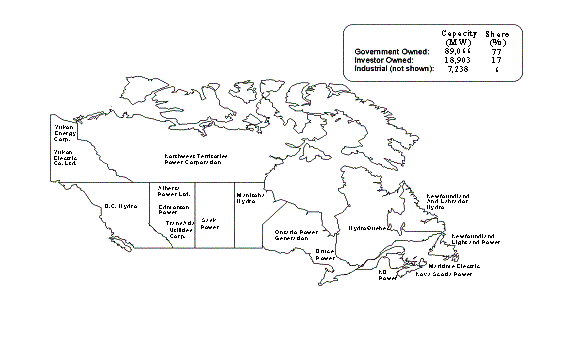
As a result of the division of the energy policy jurisdiction, Canada's electricity industry is organized along provincial lines. In most provinces the industry is highly integrated, with the bulk of the generation, transmission and distribution provided by a few dominant utilities. Although some of these utilities are privately owned, most are Crown corporations owned by the provinces. Among the major electric utilities, seven are provincially owned, seven are investor owned, two are municipally owned, and two are territorial Crown corporations. Provincial electric utilities own about 80 per cent of Canada's total installed generating capacity and produced around 75 per cent of total generated electricity.
Traditionally, there have been three nuclear utilities in Canada: Ontario Power Generation (OPG), Hydro-Quebec and New Brunswick Power. A fourth, Bruce Power Inc., was added to the list in May 2001 when it leased the 8 reactors at the Bruce generating station from OPG.
The electric power industry has a significant presence within the Canadian economy. In 2002, the electric power industry contributed to 2.4 percent of Canada's GDP and more than 85, 000 people were directly employed by the industry. The total operating revenues of the electric utilities amounted to about $53 billion, last year. Of this total, approximately $1.8 billion came from export earnings.
FIG. 1. Major Generating Utilities in Canada -2002
1.3.2. Policy and Decision Making Process
The provincial electric power utilities are responsible for electricity supply and make decisions about the type of technology to be used for electricity generation; they are also responsible for building, operating and maintaining provincial power facilities, including nuclear facilities. Utilities with nuclear plants in operation in Canada are: OPG, Bruce Power (a private consortium whose principal shareholders are Cameco Corporation (31.6%), TransCanada PipeLines (31.6%), the BPC Generation Infrastructure Trust of Toronto (31.6%) and the remaining 5.5% is owned by two unions), New Brunswick Power and Hydro-Québec. Apart from Bruce Power, which is a newcomer in the electric power scene, the three provincial utilities, particularly OPG, have had critical roles to play in the development of Canada's nuclear programme. They have worked closely with AECL in the design and construction of the power reactors in their respective provinces.
1.3.3. Main Indicators
Canada ranks sixth in the world with an installed generating capacity of about 113 GW (behind the United States, Japan, China, the Russia Federation, and Germany), accounting for about 3.6 per cent of the world total. In terms of fuel type, Canada's hydro capacity is the second largest in the world, next to the U.S. In 2002, Canada's nuclear capacity ranked 6th in the world, and represented close to 13 per cent of its electricity supply .
Electricity is vital to almost every aspect of the Canadian economy and is projected to continue to expand its role over the next century. From 1980 to the end of 2002 net electricity generation increased at an annual average rate of 2 per cent, compared with real GDP of 2.8 per cent, and total population growth of 1.1 per cent. Canada's total electricity consumption in 2002 was 556 TWh with per capita consumption of 17,314 kWh. In the same year, total electricity produced amounted to 576 TWh.
TABLE 5. ELECTRICITY PRODUCTION AND INSTALLED CAPACITY
|
|
|
|
|
|
|
|
Average annual |
|
|
|
|
|
|
|
|
|
growth rate (%) |
|
|
|
|
|
|
|
|
|
1970 |
1990 |
|
|
1970 |
1980 |
1990 |
2000 |
2001 |
2002 |
To |
To |
|
|
|
|
|
|
|
|
1990 |
2002 |
|
|
|
|
|
|
|
|
|
|
|
Electricity production (TW.h) |
|
|
|
|
|
|
|
|
|
- Total (1) |
204.72 |
377.52 |
482.03 |
585.98 |
589.71 |
588.77 |
4.37 |
1.68 |
|
- Thermal |
47.05 |
85.95 |
116.34 |
158.68 |
158.74 |
159.19 |
4.63 |
2.65 |
|
- Hydro |
156.71 |
253.07 |
296.85 |
358.41 |
358.42 |
358.42 |
3.25 |
1.58 |
|
- Nuclear |
0.97 |
38.50 |
68.84 |
68.68 |
72.35 |
70.96 |
23.76 |
0.25 |
|
- Geothermal |
|
|
|
|
|
|
|
|
|
Capacity of electrical plants (GWe) |
|
|
|
|
|
|
|
|
|
- Total |
42.83 |
82.00 |
104.12 |
111.12 |
111.84 |
112.97 |
4.54 |
0.68 |
|
- Thermal |
14.29 |
28.36 |
31.37 |
33.73 |
34.27 |
34.99 |
4.01 |
0.91 |
|
- Hydro |
28.30 |
47.77 |
59.38 |
67.30 |
67.46 |
67.80 |
3.78 |
1.11 |
|
- Nuclear |
0.24 |
5.87 |
13.37 |
10.02 |
10.02 |
10.02 |
22.26 |
-2.38 |
|
- Geothermal |
|
|
|
|
|
|
|
|
|
- Wind |
|
|
|
0.08 |
0.10 |
0.16 |
|
|
|
|
|
|
|
|
|
|
|
|
|
|
|
|
|
|
|
|
|
|
|
(1) Electricity losses are not deducted. |
|
|
|
|
|
|
|
|
|
(*)
Energy values are in Exajoule except where indicated. |
|
|
|
|
|
|
||
TABLE 6. ENERGY RELATED RATIOS
|
|
|
|
1970 |
1980 |
1990 |
2000 |
2001 |
2002 |
|
|
|
|
|
|
|
|
|
|
|
Energy consumption per capita (GJ/capita) |
306 |
378 |
388 |
474 |
472 |
470 |
||
|
Electricity per capita (kW.h/capita) |
|
9,489 |
13,810 |
16,810 |
17,264 |
17,099 |
17,314 |
|
|
Electricity production/Energy production (%) |
28 |
36 |
35 |
27 |
28 |
28 |
||
|
Nuclear/Total electricity (%) |
|
|
|
10 |
14 |
12 |
12 |
13 |
|
Ratio of external dependency (%) (1) |
|
-5 |
-6 |
-22 |
-41 |
-42 |
-43 |
|
|
Load factor of electricity plants |
|
|
|
|
|
|
|
|
|
- Total (%) |
|
|
55 |
53 |
53 |
60 |
60 |
59 |
|
- Thermal |
|
|
38 |
35 |
42 |
54 |
53 |
52 |
|
- Hydro |
|
|
63 |
60 |
57 |
61 |
61 |
60 |
|
- Nuclear |
|
|
46 |
75 |
59 |
78 |
82 |
81 |
|
|
|
|
|
|
|
|
|
|
|
|
|
|
|
|
|
|
|
|
|
(1)
Net import / Total energy consumption. |
|
|
|
|
|
|
|
|
Source: IAEA Energy and Economic Database.
2. NUCLEAR POWER SITUATION
2.1. Historical Development and current nuclear power organizational structure
2.1.1 Overview
Canada has developed a successful nuclear programme based on the unique heavy water natural uranium reactor system (now known as CANDU), which uses pressurized fuel channels instead of a pressure vessel, natural uranium instead of enriched uranium and heavy water as coolant/moderator instead of light water as coolant/moderator found in the pressurized water reactor designs.
Since the early 1950's, Canada has pursued the nuclear power option through the development of the CANDU system. Canada decided to proceed with the nuclear programme (a) because it had accumulated considerable experience in the heavy water natural uranium reactor system which enabled Canada to make use of Canadian resources and technology; and (b) because in some regions of Canada (particularly Ontario) major hydro resources had been largely developed and fossil fuels would have to be imported; and (c) because it had abundant supplies of uranium.
The main milestones of the Canadian nuclear programme are:
·
In 1955, AECL, OPG and Canadian General Electric
made a commitment to build the first small-scale prototype 22 MW CANDU reactor
at Rolphton, Ontario;
·
A larger prototype was constructed at Douglas
Point, Ontario. The 200 MW reactor went into service in 1967; these two reactors
established the technological base for the larger commercial units to follow
and for Canada's nuclear programme;
·
Two 500 MW(e) reactors at Pickering, Ontario were
committed under a tri-partite agreement between OPG, AECL and the federal government;
OPG later committed two more units to make an integrated 4-unit station; the
units (Pickering A) came into operation between 1971 and 1973;
·
Conceptual design studies on the Bruce A station
were initiated in 1968; the 4x800 MW unit Bruce A station came into service
from 1977 to 1979;
·
AECL developed the CANDU 6 reactor design and
was successful in selling four of these in the early to mid-1970's: Gentilly-2
(Hydro-Quebec, 1973), Point Lepreau (New Brunswick, 1974), and two abroad;
·
In July 1974, OPG decided to add 4 units at the
Pickering A station; the 4 units (Pickering B) came into service from 1983 to
1986;
·
Four additional units (Bruce B), came into service
from 1984 to 1987;
·
Four 900 MW(e) units at Darlington were committed
in the early 1980's; these went into service in 1989-1994;
·
Lay up of 8 units at Bruce A and Pickering A (Bruce
unit 2 in 1995 and the remaining 7 in 1998);
·
Successful completion of the environmental assessment
of the four units laid up at Pickering A and decision to return Pickering A
to service in 2000/2001;
· In February 2001, the Canadian Nuclear Safety Commission
(CNSC) announced that it had determined that the restart of the Pickering A
units would not cause significant adverse environmental effects. The ruling
allows the CNSC to proceed to formal consideration of OPG’s application to re-start
the reactors.
·
In 2001, OPG entered into an agreement with Bruce
Power to lease its Bruce A and B nuclear generating stations. Bruce Power was
initially composed of British Energy (80%), a UK company, Cameco Corporation
(15%) and two main unions on the Bruce site.
·
At the end of 2002, a significant ownership restructuring of Bruce
Power, took place. As a result of its financial difficulties encountered in
2002, British Energy decided to sell off all of its interests in Bruce Power
to a Canadian consortium. Cameco acquired an additional 16.6% ownership stake
in Bruce Power for a combined 31.6% ownership. TransCanada PipeLines and the
Ontario Municipal Employees Retirement System each acquired 31.6%, while two
Ontario unions own the remainder.
· In September 2003, the first Pickering A reactor (Unit 4) was brought back
on-line. OPG has since turned its attention to the return
to service of the other three laid-up units. The cost and schedule to return these units to service are currently
under review and will be estimated, taking into account OPG’s experience associated
with returning Unit 4 to service.
· In early October 2003, Bruce Power
announced that Bruce A unit 4 was back to service since it was laid
up in 1998. It is currently operating at full capacity. Bruce Power is now working
on the return to service of unit 3. The restart of unit 3 is progressing well
and Bruce Power is confident that it should be operational in early 2004.
2.1.2 Current Organizational Chart(s)
The structure of the Canadian Nuclear Industry is shown in Figure 2.
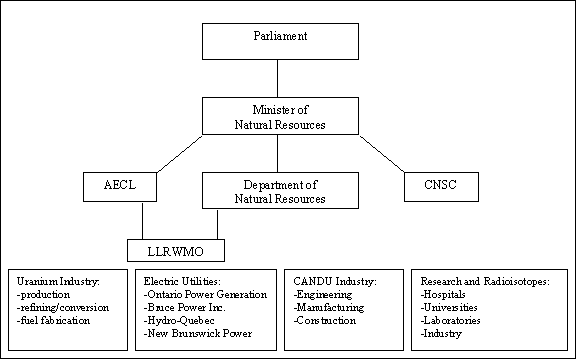
CNSC Canadian Nuclear
Safety Commission
AECL Atomic Energy of
Canada Limited
LLRWMO Low Level Radioactive Waste Management
Office
FIG.
2. Structure of the Canadian Nuclear
Industry
2.2. Nuclear Power Plants: Status and Operations
2.2.1 Domestic
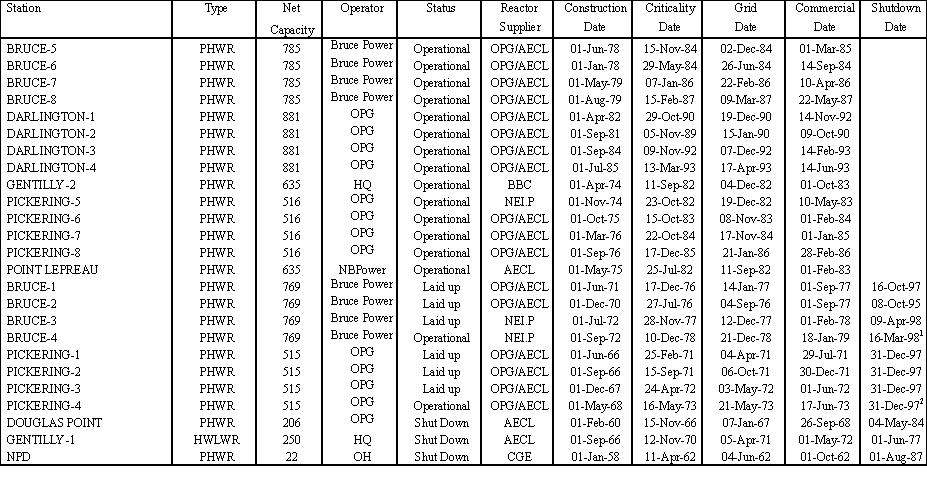
There are currently 22 nuclear power reactors in Canada which are operated by public utilities and private companies in Ontario (20), Quebec (1) and New Brunswick (1). Of the 22 reactors installed, 16 reactors are currently in full commercial operation, and they generate around 13% of Canada's electricity, over 40% in Ontario. Moreover, nine CANDU reactors are currently in operation or under construction outside of Canada. Last year, CANDU reactors in operation in Canada and abroad performed very well. Their performance averaged 85%, slightly higher than the lifetime average performance of 83%. Table 7 gives an overview of the main nuclear power data in Canada and its provinces.
TABLE 7. CANADIAN NUCLEAR POWER DATA
|
|
Canada |
Ontario |
New |
Québec |
|
Total Electricity Generation (Growth %) |
2.0 |
0.6 |
-10.0 |
3.6 |
|
Nuclear Share of Electricity Generation (%) |
12.8 |
41.0 |
21.0 |
2.5 |
|
Reactors In Service |
16 |
14 |
1 |
1 |
|
Installed Capacity (MW) |
15,795 |
14,440 |
680 |
675 |
Sources: Natural Resources Canada; and Statistics Canada.
The two nuclear operators in Ontario, OPG and Bruce Power, are still pursuing their respective recovery plans to restart the laid-up units at Pickering A and Bruce A stations. Two of the eight laid-up units were brought back to service (Pickering A Unit 4 and Bruce A Unit 4) in the second half of 2003. A third unit (Bruce A Unit 3) should be operational in early 2004
TABLE 8. STATUS OF NUCLEAR POWER PLANTS
 Sources: Natural Resources
Canada and IAEA, as of December 1, 2003.
Sources: Natural Resources
Canada and IAEA, as of December 1, 2003.
1- The Bruce A unit 4 was returned to service on October 7, 2003.
2- The Pickering A unit 4 was returned to service on September 25, 2003
OPG has also undertaken the planning for the return to service of the three remaining units at Pickering and it indicated that they should be brought back to service over the next few years. With respect to the other two units at Bruce A, Bruce Power has indicated that these units will be restarted if a proper business case can be made for returning them to service.
For most of this coming decade, prospects for new nuclear power plants in Canada are uncertain, even in Ontario, based on the most recent electricity market outlooks. The return to service of the remaining laid-up nuclear units and the completion of gas-fired units already under construction in Ontario should ensure adequate electricity supplies. While market prospects for new reactor sales in the near to medium-term are not too promising, the refurbishment of existing units holds more promise. Hence, the refurbishment of existing reactors would, at least in the medium-term, avoid the replacement of nuclear generating capacity with fossil-fuelled plants.
However, for the next decade, there are better opportunities for the deployment
of new nuclear generating capacity in Canada. AECL is currently working on the
development of the 700 MW Advanced CANDU Reactor (ACR), and is aiming at reducing
the capital cost to build a reactor by up to 40%. The economics of the new reactor
has been ranked highly by international experts relative to other advanced reactors
and has the potential to be cost competitive with other types of power generation.
The ACR technology could provide an economic replacement for existing reactors
as they reach the end of their service lives, as well as for some new nuclear
power plants in Canada and abroad.
2.3 Supply of NPPs
The Canadian nuclear industry consists of a mixture of private sector firms and public sector organizations at both the federal and provincial levels. The federal government provides leadership, support and a regulatory framework for the nuclear industry through AECL and CNSC, two federal government agencies which report to the Canadian Parliament through the Minister of Natural Resources. The Minister relies directly on the Department of Natural Resources for policy advice on nuclear matters including issues pertaining to AECL and the CNSC. The CNSC regulates the safety and security aspects of nuclear materials and facilities in Canada and participates, on behalf of Canada, in international measures of control.
AECL has both a public and commercial mandate. It has overall responsibility for Canada's nuclear research and development programme as well as the Canadian reactor design (CANDU), engineering, marketing programme. Canada also has an indigenous nuclear power industry established around the CANDU reactor technology. Private sector firms, which undertake the manufacturing of CANDU components and the engineering and project management work for reactors both inside and outside of Canada, act as subcontractors to AECL.
Through Cameco Corporation and its predecessors, both the federal and Saskatchewan governments have played a major role in Canada's uranium industry in the past. However, their role essentially ended on February 14, 2002, when the Government of Saskatchewan sold its remaining 9% ownership in Cameco.
The Canadian nuclear industry covers all phases of the nuclear fuel cycle. The industry's activities are focused on the design, engineering, construction and servicing of CANDU reactors in Canada and abroad; on fuel and component manufacturing; and, on the mining, milling, refining and conversion of uranium. The most significant members of the industry are AECL, the CNSC, provincial utilities, and private sector firms involved in equipment manufacturing, engineering and the mix of private and government (both domestic and foreign) firms involved in uranium production. In addition, there are about 125 hospitals and universities across Canada performing isotope studies in research and/or nuclear medicine.
AECL is responsible for engineering, nuclear design, business management, and construction of CANDU reactors in Canada and abroad. It leads the marketing and sales initiatives on behalf of Canada's nuclear industry. It also manages contracts for building the reactors and servicing them. AECL's CANDU operations are based in Mississauga and Chalk River, Ontario; and Montreal, Quebec. It also maintains offices around the world.
The industry is not vertically integrated. There are over 150 companies that supply products and/or services to AECL and the utilities. 58% of these firms are located in Ontario, 14% in Alberta and 12% in Quebec. The remaining provinces have 16% of the suppliers to the nuclear industry. 56% of the nuclear industry supplier companies are in the manufacturing sector, 20% are in engineering and design and 16% in R&D. In 2002, annual employment, direct and indirect, associated with the nuclear industry in Canada was over 30,000.
Manufacturing: Because of the cyclical nature of the nuclear industry, most of the firms are also active suppliers to other industries.
Engineering: A number of Canadian engineering consulting firms, working closely with AECL, assume the conventional design responsibilities as well as project and construction management and other services, which are often required during plant construction.
Operation and Maintenance: A number of private sector suppliers work as sub-contractors for provincial utilities for some of the O&M work.
Construction: This business is cyclical in nature and the impact on employment can be significant (for example, the construction of a CANDU 6 requires 15,000 person-years over the construction period of 4-5 years). The construction of reactors is undertaken by general construction contractors.
2.3.1. Status of the International Nuclear Programme
Offshore markets have been the major component of the CANDU business during the past decade and indications are that this situation might continue for some time.
AECL assisted India in the construction of two 200 MW Douglas Point-type reactors (RAPP 1 and RAPP 2). An agreement was signed with India in 1963 to build RAPP 1 and RAPP 1 was completed in 1973. Assistance for the construction of RAPP 2 was terminated following India's explosion of a "peaceful nuclear device" in 1974 although India eventually completed RAPP 2 in 1981 without Canadian involvement. Canada does not have a nuclear co-operation agreement with India and therefore cannot conduct nuclear trade with India.
In 1964, CGE entered into an agreement with Pakistan to supply a 120 MW CANDU-type reactor (KANUPP). The plant entered commercial operation in 1972. As Pakistan did not agree to meet the requirements of Canada's 1974 non-proliferation policy, Canada terminated nuclear co-operation with Pakistan. Canada does not have a Nuclear Co-operation Agreement in place with Pakistan although some "limited" safety assistance is currently being provided through the CANDU Owners Group.
AECL developed the CANDU 6 reactor design and was successful in selling four of these in the early to mid-1970's: Gentilly-2 (Hydro-Quebec, 1973), Point Lepreau (New Brunswick, 1974), Cordoba (Argentina, 1973) and Wolsong (South Korea, 1976). All four of these units went into service in the early 1980's. In 1979, an agreement was signed with Romania to build a multi-unit 650 MWe CANDU station at Cernavoda. The first reactor, Cernavoda 1, was completed and went into commercial operation in 1996.
In the 1990's, AECL sold an additional CANDU 6 unit to South Korea and a further two units in 1992. In 1996, AECL entered the Chinese market by selling two CANDU 6 reactors to the China National Nuclear Corporation. Last year, an agreement was reached with Romania to complete the second unit at the Cernavoda nuclear station.
Currently, there are 9 CANDU reactors of the CANDU-6 design in operation or under construction outside of Canada. There are four CANDU reactors in operation in South Korea, two in China and one reactor in each of the following countries: Argentina and Romania. One CANDU reactor is under construction in Romania.
The first two CANDU 6 units in Qinshan, China reached full commercial operation in 2002-2003. The completion of the two units was ahead of schedule and on budget. Construction to complete the second CANDU 6 reactor in Romania resumed in early 2003 and it is expected to be completed in 2006.
2.4 Operation of NPPs
As noted earlier, all Canadian electric utilities are under provincial jurisdiction and are responsible for building, operating and maintaining provincial power facilities, including nuclear facilities. The utilities operating nuclear facilities, are OPG, Bruce Power, Hydro-Québec and New Brunswick Power. Operation and maintenance of reactors provides the largest single source of jobs in the nuclear industry. Private sector suppliers work as sub-contractors for utilities for some of this work.
The utilities are members of the CANDU Owners Group (COG) and share in funding the industry's R&D effort. COG was formed in mid-1984 by the Canadian utilities, which own CANDU reactors, and AECL. COG was set up to promote closer co-operation among the nuclear utilities in matters relating to plant operations and maintenance and to foster co-operative development programmes leading to improved plant performance.
2.5 Fuel Cycle and Waste Management
2.5.1. Uranium
Canada is the world's leading producer and exporter of uranium, with output of some 11 607 tU in 2002 representing about 32% of total world production. In 2002, all uranium produced came from higher-grade, lower-cost production centres at Key Lake, Rabbit Lake, Cluff Lake, McClean Lake and McArthur River in Saskatchewan's Athabasca Basin. Canada's largest uranium producer, Cameco Corporation, also operates Canada's only uranium refining and conversion facilities at Blind River and Port Hope, Ontario respectively. Table 9 contains the uranium data for Canada. Fuel Fabrication in Canada is carried out by two companies, which produce fuel assemblies for the CANDU reactor. There are no uranium enrichment and reprocessing facilities in Canada.
The key companies involved in the nuclear fuel cycle in Canada are Cameco Corporation, COGEMA Resources Inc. (uranium mining and milling); Cameco (refining and conversion); and General Electric Canada Inc. and Zircatec Precision Industries Inc. (fuel fabrication).
TABLE 9. CANADIAN URANIUM DATA.
|
|
2002 |
2001 |
2000 |
1999 |
1998 |
|
Known Uranium Resources Recoverable from Mineable Ore (1,000 tU as of January 1)* |
452 |
437 |
417 |
433 |
419 |
|
Total Primary Production
(tU) |
11 607 |
12 522 |
10 683 |
8 214 |
10 922 |
|
By-product** Production
(tU) [not included above] |
0 |
0 |
0 |
0 |
0 |
|
Total Producer Shipments
(tU) |
13 042 p |
12 922 p |
9 921 |
10 157 |
9 984 |
|
Value of Shipments ($C millions) |
600 p |
600 p |
485 |
500 |
500 |
|
Average Price for Deliveries under Export Contracts ($C/kgU) / ($US/lb U3O8) |
NA |
46.60/11.60 |
47.70/12.40 |
49.10/12.70 |
51.10/13.30 |
|
Exports of Uranium of Canadian
Origin (tU) |
11 534 |
10 029 |
10 966 |
7 146 |
8 274 |
|
Uranium Exploration Expenditures ($C millions) |
35 |
25 |
46 |
49 |
60 |
*Resources at prices of $150/kgU or less.
**Uranium from refinery/conversion facility by-products recovered at Elliot
Lake. With the closure of Rio Algom's Stanleigh operation in mid-1996, by-products
from Cameco's refinery/conversion facilities in Ontario are no longer processed
in Canada.
p provisional
N/A - Not available at this time. Commencing in 2002, Natural Resources Canada
decided to suspend the publication of the Average Price of Deliveries under
Export Contracts for uranium for a period of three to five years, pending a
policy review and assessment of market conditions. The Price was designed to
reflect the international selling price for Canadian uranium. However, the international
trend in recent years toward "open-origin" uranium sales contracts
has made it increasingly difficult to isolate a figure applicable only to Canadian
uranium. Natural Resources Canada may resume publication of pricing information
in the future, if changed market conditions allow it to calculate an average
price that is clearly applicable to Canadian uranium.
Recent Uranium Developments
Mining began at the McArthur Rive mine, the site of world's largest high-grade uranium deposit discovered to date, in December 1999. Commercial production was achieved in 2000 and the mine produced 3 740tU, 6 639 tU and 7 082tU in 2000, 2001 and 2002, respectively. In January 2001, McArthur River's total reserves and resources were increased by more than 50%, bringing total reserves and resources to some 160 000 tU, with an average grade of 18%U. Production was temporarily suspended for about 3 months to repair damage caused by flooding that occurred in April 2003.
All McArthur River ore is processed at the Key Lake mill, where the high-grade ore is blended down with stockpiled, mineralised Key Lake waste rock to produce a mill feed grade of about 3.4%U. In 2000, 2001 and 2002 the Key Lake waste rock contributed 402 tU, 299 tU and 117 tU, respectively, to total production.
After commissioning in 1999, production at McClean Lake reached licensed capacity (2 308 tU) by the end of October 2000. The mill, fed by stockpiled ore from the mined-out Sue C and JEB deposits, produced 2 540 and 2 342 tU in 2001 and 2002, respectively. Together, stockpiled ore is expected to provide mill feed until 2005. In its 2001 CNSC licence, majority owner and operator COGEMA Resources Inc. (CRI) received an annual production increase of 769 tU for the facility. In 2003, CRI requested that the McClean Lake licence be amended to authorize mining of the Sue E deposit, with a decision expected in 2004.
Mining ended at Cluff Lake in May 2002 and all stockpiled ore was milled by the end of December 2002, bringing to a close a long and successful chapter in Canadian uranium mining. In the process of producing some 24 000 tU in its 22 years of operation, the Cluff Lake mine set high standards for uranium production and workplace safety. Once an environmental assessment of the closure and remediation plan is completed and all regulatory approvals have been obtained, CRI will begin the decommissioning process.
Rabbit Lake produced 1 755 tU and 440 tU in 2001 and 2002, respectively. This sharp decline in output is the result of a decision by the operator in 1998 to temporarily suspend mining and milling at the site due to market conditions. Following the development of a revised mining plan, the Eagle Point underground mine was re-opened in July 2002 and the mill in August 2002. However, poor ground conditions encountered since the re-opening have reduced output.
Environmental management systems at the McArthur River mine and the Key Lake mill were certified under the ISO 14001 standard in 2002. The McClean Lake mine and mill, as well as the Blind River refinery and Port Hope conversion plant, have already achieved this internationally recognised standard that outlines key requirements that companies should comply with in order to operate in an environmentally responsible manner. Thus, environmental management of the front end of the nuclear fuel cycle meets rigorous international standards in Canada.
In October 2000, Cameco Corporation announced that it had signed an agreement with British Energy Plc to acquire a 15% interest in the Bruce Power Partnership (Bruce Power). Under the terms of the agreement, Cameco will have the full responsibility to manage all of Bruce Power's fuel procurement needs. On December 23, 2002, Bruce Power announced that a consortium of Canadian-based companies had agreed in principle to purchase British Energy's share of Bruce Power. After the transaction closed on February 14, 2003, Cameco, TransCanada PipeLines Limited and BPC Generation Infrastructure Trust of Toronto each owned a 31.6% interest in Bruce Power, with the remaining 5.2% held by the Power Worker's Union and the Society of Energy Professionals.
2.5.2. Canadian Uranium Industry Highlights
Canada retained its position as world leader in uranium production in 2002 with output totalling 11 607 tU (tonnes of uranium metal), down slightly from the 2001 total mainly due to reduced Rabbit Lake output. As of January 1, 2003, Canada's recoverable uranium resources amounted to 439 000 tU, down slightly from the 2002 total of 452 000 tU due to extraction and ongoing deposit appraisal. With over 85% of the resource base categorized as "low-cost", Canada is well positioned to continue its leadership in uranium production.
Canadian uranium production is expected to decline somewhat in 2003, however, since the Cluff Lake facility was closed in December 2002 and production at the McArthur River mine was temporarily suspended for about 3 months to repair damage caused by flooding that occurred in April 2003. Cigar Lake, currently in care and maintenance, could begin production as early as 2006, with favorable market conditions and regulatory approvals.
2.5.3. Federal Environmental Assessment Reviews
Most nuclear projects undergo a federal environmental assessment process under the Canadian Environmental Assessment (CEA) Act. Recent developments include:
The Federal Court of Canada issued an order on September 23, 2002, that quashed a 1999 McClean Lake operating licence on the grounds that an environmental assessment (EA) under the CEA Act had not been conducted prior to issuing the licence. An appeal court subsequently ordered the decision stayed pending the disposition of the appeal, which is expected to be heard in early 2004. Until the appeal process is completed, uncertainty exists in the environmental assessment requirements for uranium mines in Canada.
The Federal Court of Canada decision is not related to the environmental performance of the facility, but is based upon the interpretation of the transitional provision of the CEA Act. The entire McClean Lake operation was reviewed by an environmental review panel pursuant to regulatory requirements that preceded the CEA Act.
On April 22, 2003, CRI initiated a "mitigative" EA, triggered by a licence amendment request to the CNSC. On August 29, 2003, guidelines for the screening were approved by the CNSC and on October 30, 2003, the project "Continuation of Ore Processing at the McClean Lake Operation" was announced. The EA will examine the development, mining and milling of the Sue E ore reserves and the management of waste rock and tailings and the development of mine rock storage areas.
An application by Cameco for a Cigar lake construction licence, in light of the McClean Lake court decision, caused the CNSC to require Cameco to initiate a EA entitled "Construction and operation of the Cigar Lake uranium mine" on January 8, 2003. On August 29, 2003, the CNSC approved guidelines for this EA.
CRI began an EA under the CEA Act of its plan to close and decommission the Cluff Lake operation in April 1999. An EA that outlines, among other issues, the decommissioning plan as well as options and mitigation measures, has been submitted to the CNSC for review. Development of this document has already involved public consultation, and additional public consultation will take place once the EA is finalised.
An EA that addresses the disposition of waste rock from the Cigar Lake mine was initiated on October 11, 1999, and the first draft was completed August 2001. Proponents addressed comments raised by federal and provincial authorities on this draft and re-submitted a revised document. Following a public hearing on June 25, 2003, the CNSC announced that the EA screening report was complete and met all of the applicable requirements of the CEAA.
2.5.4. Radioactive Waste Management
In July 1996, the Government of Canada announced a Policy Framework for Radioactive Waste. The Framework lays out the ground rules and sets the stage for the further development of institutional and financial arrangements to implement disposal of radioactive waste in a safe, environmentally sound, comprehensive, cost-effective and integrated manner. The Policy Framework specifies that the federal government has the responsibility to develop policy, to regulate, and to oversee radioactive waste producers and owners in order that they meet their operational and funding responsibilities in accordance with approved disposal plans. The Framework recognizes that there will be variations in approach in arrangements for the different waste types in Canada, i.e., nuclear fuel waste, low-level radioactive waste and uranium mine and mill tailings.
2.5.5. Radioactive Waste
In April 2001, consistent with the Policy Framework for Radioactive Waste,
the Government of Canada introduced new legislation for the long-term management
of nuclear fuel waste. The Nuclear Fuel Waste (NFW) Act is the culmination of
many years of federal research, environmental assessments and discussions with
stakeholders, including the nuclear industry, provinces and the public. The
NFW Act entered into force on November 15, 2002.
2.5.5.1. Nuclear Fuel Waste
The NFW Act requires nuclear utilities to form a waste management organization
whose mandate is to propose to the Government of Canada approaches for the long-term
management of nuclear fuel waste, and to implement the approach that is selected
by the Government. The NFW Act also requires the utilities and AECL to establish
trust funds to finance the implementation of the selected long-term nuclear
fuel waste management approach.
The Nuclear Waste Management Organization (NWMO) was established by the nuclear utilities in the fall of 2002. Its president, Ms. Elizabeth Dowdeswell, has held a number of senior posts within government and non-government organisations, and had been active in environment-related programs.
The NFW Act requires that by November 15, 2005, the NWMO submit to the Government a study setting out its proposed approaches for the long-term management of nuclear fuel waste, and its recommendation on which proposed approach should be adopted. The NFW Act requires the NWMO to include in the study approaches based on both storage (on-site or centralized) and disposal. In carrying out this study, the NWMO must consult with the general public on each of the proposed approaches.
The Government of Canada will select one of the approaches for the long-term
management of nuclear fuel waste from among those set out in the study, and
the NWMO will then be required to implement the selected approach. This implementation
will be funded through monies deposited in trust funds set up by the utilities
and AECL in accordance with requirements in the NFW Act.
2.5.5.2. Low-Level Radioactive Waste
The major nuclear utility in Canada, OPG, produces about 70% of the annual
volume of low-level radioactive waste in Canada. To date, there has been no
pressing need in OPG for early disposal; volumes are small and the waste is
being safely stored on an interim basis. However, in its 1992 plan for these
wastes, the utility fully recognized that, in the longer term, disposal is a
necessary step in responsible waste management, so that future generations are
not burdened with managing this waste. OPG is currently assessing possible options
for the long-term management of low and intermediate level radioactive wastes.
The year 2015 is considered an achievable target date for bringing a long-term
management facility into service.
The other major ongoing producer of low-level radioactive waste, AECL, had discussions
with the CNSC to license a prototype below-ground concrete vault known as IRUS
(Intrusion-Resistant Underground Structure) for relatively short-lived waste.
The future application of IRUS technology is currently being reassessed by AECL.
Until this, or another disposal facility is available, AECL will continue to
store its on-going LLW in-ground and above-ground structures.
2.5.5.3. Port Hope Area Wastes
The bulk of Canada's historic low-level radioactive waste is located in the southern Ontario communities of Port Hope and Clarington. These wastes, amounting to roughly one million cubic metres, relate to the historic operations of a radium and uranium refinery in the municipality of Port Hope. In March 2001, the Government of Canada and the local municipalities where the wastes are located entered into an agreement for the long-term management of these wastes. The Project will involve the cleanup of the wastes and long-term management in newly constructed above-ground mounds in the local communities. The $260 million project will take roughly ten years to complete. The first phase of the Project is an environmental assessment and regulatory review that is expected to last five years. Cleanup, waste facility construction, and waste emplacement would take place in the following five years.
2.5.5.4. Radioactive Contamination in Northern Alberta and Northwest Territories
Uranium ore was mined in the 1930s, 1940s and 1950s at Port Radium on Great Bear Lake in the Northwest Territories by the uranium mining company Eldorado. It was transported by barge to Fort McMurray in northern Alberta, where the cargo was put on rail and transported to southern Ontario for processing. Cargo spills occurred at barge transfer points. Although the radiological impact of the contaminated sites discovered in 1991 is minimal, the federal government nevertheless decided to conduct a phased project involving clean-up activities based on sound waste disposal principles. Action has been taken annually since 1991 in the areas of site characterization, clean up, and monitoring activities. This project is on-going.
2.5.5.5. Uranium Mine and Mill Tailings
In Canada, about 225 million tonnes of uranium mine and mill tailings have been generated since the mid-1950s. These comprise about two percent of all mine and mill tailings in the country. Most of the existing uranium tailings are located in the provinces of Ontario and Saskatchewan. Of the total of twenty-four tailings sites in Canada, only three in Saskatchewan continue to receive waste material.
Uranium tailings are decommissioned on-site. The mining industry, in cooperation with provincial and federal governments has, over the past two decades, funded a comprehensive research program on acid rock drainage. Technologies developed under this program have been successfully applied to the decommissioning of uranium tailings in the provinces of Ontario and Saskatchewan, in addition to other sites across Canada.
With regard to financial responsibility for decommissioning and long-term maintenance of the tailings, the CNSC requires that present-day operators provide financial assurances that decommissioning of uranium facilities will take place in a responsible and orderly manner in the short- and long-term. Where a producer or owner cannot be identified, cannot be located, or is unable to pay, responsibility for decommissioning would rest with the Canadian federal and provincial governments. In January 1996, a Memorandum of Agreement (MOA) on cost-sharing for management of abandoned uranium mine tailings was signed between the federal and Ontario governments. The MOA recognizes that present and past producers of uranium are responsible for all financial aspects of the decommissioning, and long-term maintenance of uranium mine sites, including the tailings. In the case of abandoned sites, the MOA outlines how governments will share the long-term management responsibilities and associated costs.
2.5.5.6. Decommissioning Reactors
CANDU reactors are to be decommissioned in a staged fashion. NPD (a 25 MW(e) reactor), Douglas Point (a 220 MW(e) reactor) and Gentilly-1 (a 266 MW(e) reactor), all owned by AECL, are in a shutdown phase. The nuclear fuel waste has been stored and the containment buildings are intact. After a period of about 30 years, remaining structures will be dismantled, the site restored and the waste disposed of off-site.
2.6 Research and Development
The federal government has funded the research and development programme of Atomic Energy of Canada Limited since AECL was first established in 1952. As part of its overall review of federal programmes in 1995-96, the Department of Natural Resources reviewed the structure and funding of the AECL R&D programme in co-operation with other key departments and AECL. As a result of the review, federal funding was reduced to $100 Million per annum and a strategic decision was taken to focus AECL's R&D efforts on CANDU-related R&D and close the AECL laboratories at Whiteshell. The government's objective was to maintain a viable R&D programme at reduced cost to the federal government. AECL receives commercial revenues from its customers and also receives government appropriations for its nuclear R&D programme.
AECL is responsible for Canada's nuclear research and development programme, which includes activities in support of CANDU technology as well as basic science activities to support AECL's applied programmes in the nuclear, biological and material sciences. AECL's internationally acclaimed research centre at Chalk River, Ontario plays a critical role in the development of the CANDU reactor, safety and environmental protection, nuclear medicine, health sciences, in nuclear fuel waste management and the basic sciences that spawn technological advances in these areas.
Nuclear research and development in Canada began in the 1940s as a responsibility of the federal government. The Chalk River Laboratories (CRL) were originally established as a part of the National Research Council's wartime research effort. Early CRL pursuits were in the "new" sciences at the time - nuclear physics, nuclear chemistry and radiation biology - and the creation of the National Research Experimental (NRX) reactor.
The NRX facility and the National Research Universal (NRU) reactor (brought on stream a decade later) were critical to CRL's early programmes of basic science and isotope production as well as to the development of the CANDU reactor system. CRL supported federal government initiatives to develop national radiological health and safety regulations and to contribute to international efforts to control the proliferation of nuclear weapons.
The CANDU nuclear energy system is unique in concept among nuclear systems in the world. This is because the Canadian research reactors were designed to use natural (rather than enriched) uranium and heavy (rather than light) water. Consequently, the required R&D support is unique and cannot be derived from research results in other countries. Therefore, a continuing CANDU R&D programme is necessary to support existing and future plants, both at home and abroad.
Although responsibility for the design, construction and operation of nuclear power plants has generally been shared between AECL, the nuclear power utilities and private companies, most of the related R&D activities have remained in the AECL laboratories. Such activities have included the development of CANDU design methods, experimental verification of CANDU reactor components and design characteristics, as well as detailed safety analyses. Work continues on improved durability and reliability of CANDU components, and flexibility of fuel cycles. Significant research in basic and applied science, not necessarily related to nuclear energy, has also been conducted in these laboratories.
The continuing design and development programme for pressurized heavy water reactors (PHWR) in Canada are primarily aimed at reduction of plant costs through plant optimization and simplification and at an evolutionary enhancement of plant performance and safety. Two new 728 MW(e) CANDU-6 units with improvements over earlier versions of this model have been successfully constructed under budget and ahead of schedule in Qinshan, China. AECL is developing its next generation Advanced CANDU Reactor (ACR) to incorporate further evolutionary improvements to enhance safety, improve efficiency and to reduce construction times and costs. New features include smaller core size, evolutionary fuel-bundle design using slightly enriched uranium and the use of light water as coolant. The ACR is undergoing pre-licensing review in Canada and the United States.
A second major nuclear R&D initiative that Canada is involved in is Generation IV. AECL has also the lead on the Generation IV International Forum's (GIF) Super Critical Water-Cooled Reactor (SCWR) Initiative. Canada, through its participation in GIF, has committed to support the Forum in its search for advanced reactor systems to meet the energy needs of the future (~2030).
2.7 International Co-operation and Initiatives
Private and public organizations in Canada's nuclear programme are active in bilateral co-operative work in many countries often under the umbrella of a Memorandum of Understanding between parties. Co-operative work is carried out with countries with which Canada has established formal nuclear relations under a Nuclear Co-operation Agreement. Canadian public and private sector firms are also active in a variety of multilateral activities carried out in a number of international nuclear fora including the International Atomic Energy Agency (IAEA), the Nuclear Energy Agency (NEA) of the Organization for Economic Co-operation and Development (OECD), the G-7 Nuclear Safety Working Group, etc.
3. NATIONAL LAWS AND REGULATIONS
3.1. Safety Authority and the Licensing Process
The Canadian Nuclear Safety Commission
On 31 May 2000, the Canadian Nuclear Safety Commission (CNSC) was created as the successor to the Atomic Energy Control Board (AECB), which had served as the regulator of Canada's nuclear industry for more than 50 years. The Commission's creation followed the coming into force of the Nuclear Safety and Control (NSC) Act and its regulations. The NSC Act represented the first major overhaul of legislation governing Canada's nuclear regulatory regime since the AECB was established in 1946. It established a seven-member tribunal (the Commission) to regulate the nuclear industry, and authorized the Commission to hire technical and support staff. The Commission reports to Parliament through the Minister of Natural Resources.
The CNSC's mission is to regulate the use of nuclear energy and materials to
protect health, safety, security and the environment and to respect Canada's
international commitments on the peaceful use of nuclear energy. Under the NSC
Act, the CNSC's mandate involves four major areas:
· Regulation of the development, production and use of nuclear
energy in Canada;
· Regulation
of the production, possession and use of nuclear substances, prescribed equipment
and prescribed information;
· Implementation of measures respecting international control
of the use of nuclear energy and substances, including measures respecting the
non-proliferation of nuclear
weapons; and
· Dissemination of scientific, technical and regulatory information
concerning the activities of the CNSC and the effects on health and safety and
the environment arising from the development and use of nuclear energy and nuclear
substances.
The Canadian regulatory system is designed to protect people and the environment from the risks associated with the development and use of nuclear energy and nuclear substances. Companies or medical or academic institutions wishing to operate nuclear facilities or use nuclear substances for industrial, medical or academic purposes must first obtain a licence from the CNSC. It is a fundamental tenet of Canada's regulatory regime that licensees are primarily responsible for safety. The CNSC's role is to ensure that the applicants live up to their responsibility. The onus is therefore on the applicant or the holder of the license to justify the selection of a site, design, method of construction, and mode of operation of a facility, etc. When issuing a licence, the CNSC must be satisfied that the companies have taken adequate measures to protect health and safety, the environment, security and to respect international commitments, and that the companies are qualified to carry out the licensed activities. Licensing matters for major facilities are carried out in public hearings by the seven-member tribunal. This is one of the most visible functions of the CNSC in the regulation of the nuclear industry.
The CNSC controls the import and export of nuclear materials, nuclear technology and equipment that might be used to develop nuclear weapons (including so-called "dual use items"). CNSC staff also plays an important role in international activities aimed at the non-proliferation of nuclear weapons. As well, the CNSC participates in IAEA activities and ensures compliance with Canada's Nuclear Non-Proliferation policy and the Treaty on the Non-Proliferation of Nuclear Weapons.
CNSC staff inspects licensed activities, enforces compliance with regulations, and develops safety standards. Standards for radiological protection have been developed over the years at both national and international levels. The basis for the Canadian regulatory radiation dose limits originates from the recommendations of the International Commission on Radiological Protection (ICRP).
3.2. Main National Laws and Regulations in Nuclear Power
While Canada's provinces have constitutional responsibility for resource and industrial development, including authority for decisions regarding the development of uranium resources and the commercial development and use of nuclear power, regulation of the nuclear industry is a federal responsibility and has been since the inception of the Canadian nuclear industry in the mid-40s. While the CNSC has sole responsibility for licensing nuclear facilities and nuclear activities, a number of other federal agencies are involved in the regulation of the industry. Provinces may also have regulations that deal with off-site activities of licensees, such as provisions for off-site emergency preparedness.
The main national laws relevant to Canada's nuclear programme are the NSC Act, which came into force in 2000, the Nuclear Liability (NL) Act of 1976, and the NFW Act of 2002. Other federal legislation of significant importance to the Canadian nuclear industry include the CEA Act, which came into force in January 1995, and the Canada Labour Code, which governs conventional occupational health and safety issues, labour standards and labour relations.
3.2.1. National Regulation
As noted above, the NSC Act replaced the Atomic Energy Control Act of 1946 and established the Canadian Nuclear Safety Commission in place of the former Atomic Energy Control Board with regulatory responsibilities for nuclear matters. The NSC Act received Royal Assent in March 1997, and came into force on 31 May 2000, after new regulations in support of the Act were approved.
In addition to the powers and responsibilities of the CNSC outlined above, the NSC Act authorizes the Commission to require that operators of nuclear facilities provide financial guarantees as a condition of their licence. This is a discretionary power that the Commission has used to require operators of uranium mines and mills, uranium refineries and fuel fabrication facilities, nuclear power plants and research reactors and facilities to provide financial guarantees to support decommissioning activities and the long-term management of nuclear waste. The financial guarantees are based on decommissioning plans accepted by the CNSC, using conservative cost estimates for implementing those plans. Financial guarantees ensure that the costs for decommissioning will be borne by licensees, not taxpayers.
The NL Act, which came into force in 1976, establishes liability for third-party injury and damage arising from nuclear accidents and provides for a well-defined compensation system for victims. The NL Act is modelled closely after the Vienna and Paris nuclear third-party liability conventions. The Act applies to nuclear facilities that are designated by the CNSC. These are generally nuclear reactors, fuel fabrication facilities, or facilities for the long-term management of nuclear fuel waste. The NL Act also includes provisions for Canada to enter into reciprocity agreements with any country that provides satisfactory arrangements for compensation. Currently, the only such reciprocity arrangement is between the United States and Canada. Although the basic principles underlying the NL Act remain valid, the Act is almost thirty years old, and needs updating to address issues that have become evident over the years, and to keep pace with international trends. The federal government has conducted a comprehensive review of the NL Act, and expects to introduce new legislation sometime in 2004.
The NFW Act requires nuclear utilities to form a waste management organization whose mandate is to propose to the Government of Canada approaches for the long-term management of nuclear fuel waste, and to implement the approach that is selected by the Government. The NFW Act also requires the utilities and AECL to establish trust funds to finance the implementation of the selected long-term nuclear fuel waste management approach. The NFW Act entered into force on November 15, 2002.
The CEA Act establishes in legislation the process and the obligations of federal departments and agencies for the conduct of environmental assessments of public or private projects involving the federal government. In 2000, a five-year review of the operation and provisions of the CEA Act was undertaken by the Minister of Environment. A multi-stakeholder consultation was held on a national scale to determine ways to improve the Act. A revised CEA Act, incorporating the results of the five-year review, came into force in October 2003.
Conventional occupational health and safety, labour relations and labour standards are governed by the Canada Labour Code. Provisions in the Code allow the federal government to incorporate by reference provincial statutes of general application as federal regulations, and to make arrangements with provincial governments for the administration of those regulations. This power has been exercised with respect to nuclear power facilities in Ontario, and for conventional occupational health and safety matters at Saskatchewan uranium mines and mills.
4. CURRENT ISSUES AND DEVELOPMENTS ON NUCLEAR POWER
4.1 Energy Policy
The federal government's view is that, on balance, Canada is fortunate to have a variety of energy resource options at its disposal and that it is necessary to continue to develop a mixture of energy sources. Within the supply portfolio there is an important role for nuclear energy as long as it is responsibly managed and strictly regulated.
The provinces have overall responsibility for the development and management of their nuclear supply system, including nuclear power stations. Although the three provinces with nuclear facilities do not have any plans to build additional nuclear plants, they are undertaking or planning to undertake refurbishment programmes to ensure long-term supply from their nuclear assets. The Ontario government, which has made a significant investment in developing a nuclear energy infrastructure, recognizes that nuclear energy will remain a very important component of the supply mix and that it represents a major technical achievement.
Ontario
The two nuclear operators in Ontario, Ontario Power Generation (OPG) and Bruce Power, are making significant progress in their respective recovery plan to restart the four laid-up units at both Pickering A and Bruce A stations.
In fact, on September 25, 2003, OPG announced the return to service of Pickering
A unit 4 to the Ontario electricity market. Since then, OPG has turned its attention
to the return to service of the other three laid-up units. Although OPG has
not indicated specific dates for the return to service of the remaining three
units, it is expected that they should be brought back to service over the next
few years.
Bruce Power is also proceeding with its refurbishment program to restart the
Bruce A units. In October 2003, Bruce Power announced that Bruce A Unit 4 was
reconnected to the provincial electricity grid. Bruce Power is also working
on bringing Unit 3 to service which is expected to be in service in early 2004.
Together, the two Bruce A units will add 1,500 MW of electricity to the Ontario
grid. With respect to the other two units at Bruce A, Bruce Power indicated
that these units will be restarted only if a proper business case can be made
for returning them to service.
New Brunswick
The New Brunswick government is in the process of restructuring the electricity
market and redefining the future role of New Brunswick Power (NB Power). The
Government recently announced that it will proclaim the new Electricity Act
on April 1st 2004, which will mark the beginning of a competitive electricity
market in New Brunswick. NB Power will also be reorganized into five distinct
units as a result of the new act.
The nuclear reactor at the Point Lepreau station is approaching the point where
a decision needs to be made as to whether it should be refurbished or begin
to prepare for decommissioning. NB Power and AECL have begun a refurbishment
assessment program to determine the technical scope for refurbishment. Following
the assessment, the costs and benefits of refurbishment will be compared with
other development opportunities to determine the most viable option for NB Power.
A final decision on the project has not yet been made, but a decision is expected
sometime in 2004. Concurrently, the New Brunswick Government is exploring the
potential for private sector involvement in the project. If the refurbishment
program goes ahead, the reactor's life will be extended in 2008 for an additional
25 years.
Quebec
The Gentilly 2 nuclear reactor is also approaching the point in time where a
decision needs to be made, as it went into operation at about the same time
as the Point Lepreau station. Hydro-Quebec is currently conducting some studies,
as well as some public consultations. A decision by the Board of Directors of
Hydro-Quebec is not expected before 2005. If approved, the refurbishment of
Gentilly 2 is expected to take place in 2009 and 2010.
4.2 Privatisation and deregulation
As a result of the opening of the market in Ontario, OPG has been able to divest some of its nuclear assets. In fact, it has leased its 8 units at the Bruce station to Bruce Power, now a Canadian consortium. In December 2002, British Energy decided to relinquish its entire stake (82%) in the Bruce nuclear station to a Canadian consortium. British Energy's financial difficulties and the change in the structure of the consortium have had little impact on the operations at the Bruce plant.
From a regulatory perspective, the federal government clarified, in 2002, a section of the Nuclear Safety and Control Act (Section 46-3) which was an impediment for private sector lending to the nuclear industry. The nuclear sector can now compete for project financing on an equal footing with other sectors. This amendment has contributed to the successful change in ownership of the Bruce Power to a Canadian consortium.
4.3. Role of government in Nuclear R& D
Canada supports a diverse energy mix that includes the nuclear option. As well,
it supports climate change initiatives. Significant emissions can be avoided
through the construction of new nuclear reactors to meet increased domestic
demand for electricity or to replace older CANDUs reaching the end of their
lives. With growing concern about the reliability of the electricity supply,
particularly in Ontario, issues of refurbishment and new reactor construction
are under review by provincial governments and power utilities.
AECL is developing, with the government's support, its next generation CANDU
reactor, known as the ACR 700 MW. Safety enhancements and evolutionary design
are expected to make it 40% cheaper to build than existing CANDU technology.
Improvements include a smaller core, a 75% reduction in the quantity of heavy
water, and the use of slightly enriched uranium fuel. Its modular design promises
a faster assembly time than existing reactors.
The new design is undergoing pre-licensing assessment in the United States and Canada. New reactor builds would likely be of the ACR design presently under development by AECL for domestic and international markets. The ACR aims to be cost-competitive with other methods of power generation, including natural gas. International experts have ranked the ACR high for economics in comparison with other advanced reactor concepts. It also holds significant potential for use in Canada's oil sands recovery program as well as in hydrogen production.
Canada, through its participation in the Generation IV International Forum, has committed to support the research, design and development of a fourth generation super-critical water-cooled reactor. AECL has the lead responsibility for Canada on this particular initiative.
4.4. Nuclear Energy and Climate Change
For more than three decades, nuclear energy has contributed to avoid a significant amount of GHG emissions in Canada. Although there are a number of challenges currently facing the nuclear option, it is clear that nuclear is well positioned to continue to play an important role in meeting Canada's energy needs, as well as its air quality and climate change commitments.
As indicated earlier, nuclear energy is currently providing around 13 per cent of Canada's total electricity requirements (over 40 per cent in Ontario). This is a source of electricity, which is virtually GHG emissions free. Since the first nuclear reactor came on line in 1971, nuclear power has prevented the release of over 1,500 Megatonnes (Mt) of CO2 emissions in the atmosphere, assuming that coal was the most likely alternative to nuclear over that period.
Last year alone, Canada's use of nuclear energy precluded the release of CO2 emissions ranging between 40 to 70 Mt assuming that nuclear energy would have been displaced by natural gas and/or coal, respectively. If Canadian electric utilities had not chosen to build nuclear reactors and had built fossil-fueled plants instead, Canada's total GHG emissions gap would be 20 to 35% higher in 2010, than currently forecast.
For most of this decade, tangible prospects for any new nuclear power plants
for Canada are uncertain, even in Ontario, based on the most recent electricity
market outlooks. The return to service of laid-up nuclear units and the completion
of gas-fired units already under construction in Ontario should ensure more
than adequate electricity supplies. This is in line with the 10-year outlook
recently published by the Ontario Independent Electricity Market Operator. Moreover,
based on the most recent Levelized Unit Energy Cost1 (LUEC) published by the
Nuclear Energy Agency, the current market conditions and the fact that electricity
generated from fossil fuel sources does not internalize all of its costs results
in the nuclear option being a less economical option for new generating capacity.
However, by 2010, we foresee better opportunities for the deployment of new
nuclear generating capacity in Canada, as AECL is currently working on the development
of ACR, and it aiming at reducing the capital cost to build a reactor by up
to 40%. AECL foresees the potential for two ACRs in Canada by 2010.
While market prospects for new reactor sales in the near to medium-term are
not too promising, the refurbishment of existing units, e.g., Point Lepreau
and Gentilly 2 by 2008-09, seems more likely. Hence, the refurbishment of existing
reactors would, at least in the medium-term, avoid the replacement of nuclear
generating capacity with fossil-fuel based plants.
Over the next two decades, nuclear energy will have to face major challenges
in order to be able to compete with other technologies for generating electricity
in an open and deregulated market environment. These challenges include:
1- the ability to develop a cost competitive ACR;
2- the ability to mobilize large capital investment for projects in an open
market;
3- the siting and licensing requirement for new nuclear plants;
4- the price of fossil fuels; and
5- the development of mechanisms which will internalize the externalities related
to the production of electricity from fossil fuels.
The industry is attempting to address those challenges by investing in the development
of an advanced nuclear reactor and developing consortia to finance the refurbishment
or the construction of new reactors.
4.5 Safety and waste management issues
4.6 Other issues
REFERENCES
[1] Data & Statistics/The World Bank, www.worldbank.org/data.
[2] IAEA Energy and Economic Data Base (EEDB).
[3] IAEA Power Reactor Information System (PRIS).
Appendix 1.
International, Multilateral and Bilateral Agreements
|
|
||
|
|
||
|
Ratified: |
15 September 2000 |
|
|
|
|
|
Entry
into force: |
15 June 1966 |
|
|
|
|
|
Entry into force: |
21 February 1972 |
|
|
|
|
|
Entry into force: |
8 September 2000 |
|
|
||
|
OTHER MULTILATERAL SAFEGUARDS AGREEMENTS |
||
|
|
||
|
Entry into force: |
30 September 1971 |
|
|
|
|
|
Entry into force: |
20 June 1966 |
|
|
|
|
|
Entry into force: |
17 October 1969 |
|
|
|
|
|
Entry into force: |
10 February 1977 |
|
|
|
|
|
MAIN INTERNATIONAL TREATIES |
||
|
|
|
|
|
Entry
into force: |
8 January 1969 |
|
|
|
|
|
Entry
into force: |
8 February 1987 |
|
|
|
|
|
Entry into force: |
18 February 1990 |
|
|
|
|
|
Entry into force: |
12 September 2002 |
|
|
|
|
|
N/A |
|
|
|
||
|
|
|
|
|
Not signed |
|
|
|
|
|
|
Non Party |
|
|
|
|
|
|
N/A |
|
|
|
|
|
|
Not signed |
|
|
|
|
|
|
Entry into force: |
24 October 1996 |
|
|
|
|
|
Entry
into force: |
18 June 2001 |
|
|
|
|
|
OTHER RELEVANT AGREEMENTS |
|
|
|
|
|
|
|
Accepted: |
8 June 1989 |
|
|
|
|
|
Member |
|
|
|
|
|
|
No reply |
|
|
|
|
|
|
Member |
|
|
|
|
|
|
Adopted |
|
|
|
|
|
|
|
(1992) |
|
|
|
|
|
Signed: |
24 September 1996 |
|
|
||
BILATERAL AGREEMENTS
Canada has bilateral nuclear co-operation agreements with the following countries:
|
·
Argentina |
·
Indonesia |
·
Slovakia |
|
·
Australia |
·
Japan |
·
Switzerland |
|
·
Brazil |
·
Korea, Republic of |
·
Taiwan |
|
·
China |
·
Lithuania |
·
Turkey |
|
·
Colombia |
·
Mexico |
·
Ukraine |
|
·
Czech Republic |
·
Philippines |
·
Uruguay |
|
·
Egypt |
·
Romania |
·
United States |
|
·
Euratom |
·
Russia |
·
|
|
·
Hungary |
·
Slovenia |
·
|
Appendix 2.
DIRECTORY OF THE MAIN ORGANIZATIONS, INSTITUTIONS AND COMPANIES INVOLVED IN NUCLEAR POWER RELATED ACTIVITIES
|
FEDERAL GOVERNMENT DEPARTMENTS AND AGENCIES |
|
|
|
|
|
Nuclear
Energy Division |
|
|
Department
of Natural Resources |
Tel: (+1-613) 995-2870 |
|
580 Booth
Street |
Fax: (+1-613) 995-0087 |
|
Ottawa,
Ontario K1A 0E4 |
|
|
|
|
|
Uranium
and Radioactive Waste Division |
|
|
Department
of Natural Resources |
Tel: (+1-613) 996-2395 |
|
580 Booth
Street |
Fax: (+1-613) 947-4205 |
|
Ottawa,
Ontario, KIA 0E4 |
|
|
|
|
|
Atomic
Energy of Canada Limited |
Tel: (+1-613) 782-2021 |
|
112 Kent
Street, 5th Floor |
Fax: (+1-613) 782-2061 |
|
Ottawa,
Ontario K1A 0S4 |
|
|
|
|
|
2251
Speakman Drive |
Tel: (+1-905) 823 9040 |
|
Mississauga,
Ontario L5K 1B2 |
Fax: (+1-905) 403 7301 |
|
|
|
|
Canadian
Nuclear Safety Commission |
|
|
280 Slater
Street, 4th Floor Reception 8828 |
Tel: (+1-613) 995-5894 or 992 |
|
P.O.
Box 1046, Station B |
Fax: (+1-613) 995-5086 |
|
Ottawa,
Ontario K1P 5S9 |
|
|
|
|
|
FIRMS INVOLVED IN THE FRONT END OF THE FUEL CYCLE |
|
|
|
|
|
Cameco
Corporation |
Tel: (+1-306) 956-6200 |
|
2121
- 11th Street West |
Fax: (+1-306) 956-6302 |
|
Saskatoon,
Saskatchewan S7M 1J3 |
|
|
|
|
|
Uranerz
Exploration and Mining Limited |
|
|
410 -
22nd Street E., Suite 1300 |
Tel: (+1-306) 668-1711 |
|
Saskatoon,
Saskatchewan S7K 5T6 |
Fax: (+1-306) 652-3731 |
|
|
|
|
Cogema
Resources Inc. |
Tel: (+1-306) 343‑4502 |
|
817 -
825, 45th Street West, Box 9204 |
Fax: (+1-306) 653-3883 |
|
Saskatoon,
Saskatchewan S7K 3X5 |
|
|
|
|
|
Rio Algom
Limited |
|
|
120 Adelaide
Street West, Suite 2600 |
Tel: (+1-416) 367‑4000 |
|
Toronto,
Ontario M5H 1W5 |
Fax: (+1-416) 365-6870 |
|
|
|
|
Denison
Mines Limited |
|
|
Atrium
on Bay - Suite 320 |
|
|
40 Dundas
Street West |
Tel: (+1-416) 979‑1991 |
|
Toronto,
Ontario M5G 2C2 |
Fax: (+1-416) 979-5893 |
|
|
|
|
RELEVANT ASSOCIATIONS |
|
|
|
|
|
Uranium
Saskatchewan Association Inc. |
|
|
600 Spadina
Crescent East |
Tel: (+1-306) 242-8222 |
|
Saskatoon,
Saskatchewan S7K 3G9 |
Fax: (+1-306) 244-4441 |
|
|
|
|
Canadian
Nuclear Association |
|
|
130 Albert
Street, Suite 1610 |
Tel: (+1-613) 237-9082 |
|
Ottawa,
Ontario K1P 5G4 |
Fax: (+1-613) 237-0989 |
|
|
|
|
Canadian
Electrical Association |
Tel: (+1-613) 230-9263 |
|
60 Slater
Street, Suite 1210 |
Fax: (+1-613)
230-9326 |
|
Ottawa,
Ontario K1P 5H1 |
|
|
|
|
|
Electrical
and Electronic |
|
|
Manufacturers
Association |
|
|
10 Carlson
Court, Suite 210 |
Tel: (+1-416) 674-7410 |
|
Rexdale,
Ontario M9W 6L2 |
Fax: (+1-416) 674-7412 |
|
|
|
|
RELEVANT POWER UTILITIES |
|
|
|
|
|
Ontario
Power Generation |
|
|
700 University
Avenue |
Tel: (+1-416) 592-3453 |
|
Toronto,
Ontario M5G 1X6 |
|
|
|
|
|
Bruce
Power |
Tel.
519-361-3550 |
|
P.O.
Box 1540 |
Fax:
519-361-3325 |
|
Tiverton, Ontario, NOG 2T0 |
|
|
|
|
|
Hydro-Québec |
Tel: (+1-514)
289-3811 |
|
75, boul. René Lévesque ouest |
Fax: (+1-514)
289-3342 |
|
Montréal, Québec H2Z 1A4 |
|
|
|
|
|
SaskPower
Corporation |
Tel: (+1-306) 566-2121 |
|
2025
Victoria Avenue |
Fax: (+1-306) 566-3523 |
|
Regina,
Saskatchewan S4P 0S1 |
|
|
|
|
|
New Brunswick
Power Corporation |
|
|
515 King
Street |
Tel: (+1-506) 458-4342 |
|
P.O.
Box 2000 |
Fax: (+1-506) 458-4390 |
|
Fredericton,
New Brunswick E3B 4X1 |
|
|
|
|
|
CANDU INDUSTRY |
|
|
|
|
|
Monenco
Agra Inc. |
|
|
Monenco
Agra Building |
|
|
2010
Winston Park Drive, Suite 100 |
Tel: (+1-905) 829-5399 |
|
Oakville,
Ontario L6H 6A3 |
Fax: (+1-905) 829-5401 |
|
|
|
|
Babcock
& Wilcox Canada |
|
|
P.O.
Box 310 |
Tel: (+1-519) 621-2130 |
|
581 Coronation
Boulevard |
Fax: (+1-519) 621-8550 |
|
Cambridge,
Ontario N1R 5V3 |
|
|
|
|
|
Canatom
Inc. |
Tel: (+1-514)
288-1990 |
|
2020 University, Suite 2200 |
Fax: (+1-514)
289-9300 |
|
Montréal, Québec H3A 2A5 |
|
|
|
|
|
CAE Electronics
Ltd. |
|
|
C.P.
1800 |
Tel: (+1-514) 341-6780 |
|
Saint-Laurent, Québec H4L 4X4 |
Fax: (+1-514)
341-7699 |
|
|
|
|
Dominion
Bridge |
|
|
500 Notre-Dame
Street |
Tel: (+1-514) 634-355l |
|
Lachine,
Québec H8S 2B2 |
Fax: (+1-514) 631-2668 |
|
|
|
|
GE Canada
Inc. |
|
|
Nuclear
Products |
Tel: (+1-705) 748-7509 |
|
107 Park
Street North |
Fax: (+1-705) 748-7338 |
|
Peterborough,
Ontario K9J 7B5 |
|
|
|
|
|
RADIOISOTOPES |
|
|
|
|
|
MDS Nordion |
Tel: (+1-613) 592 3400 |
|
447 March
Road |
Fax:
(+1-613) 592 9246 |
|
Kanata, Ontario K2K 1X8 |
|
|
|
|
|
HIGH ENERGY RESEARCH INSTITUTES |
|
|
|
|
|
Canadian Institute for Synchrotron Radiation |
|
|
(CISR) |
|
|
|
|
|
TRIUMF (Canada) |
|
|
|
|
|
Centre canadien de fusion
magnétique |
|
|
(CCFM) |
|
|
|
|
|
INRS - Energie et Matériaux |
|
|
|
|
|
Plasma Physics Laboratory |
|
|
at the University of Saskatchewan |
|
|
|
|
|
UNIVERSITIES |
|
|
|
|
|
University of Saskatchewan |
|
|
|
|
|
University of Western Ontario |
|
|
|
|
|
OTHER ORGANIZATIONS |
|
|
|
|
|
Canadian Centre for Occupational |
|
|
Health and Safety (CCOHS) |
|
|
|
|
|
Canadian Coalition for |
|
|
Nuclear Responsibility (CCNR) |
|
|
|
|
|
Friends of the Earth (Canada) |
|
|
|
|
|
War, Peace and Security WWW Server |
|
|
(Department of National Defense, Canada) |
|
|
|
|
|
Energy Council of Canada (ECC) |
|
|
|
|
|
Canadian Nuclear Association |
|
|
|
|
|
Canadian Nuclear Society (CNS) |
|
|
|
|
|
Atlantic Nuclear Services Ltd. (ANSL) |
|
|
|
|
|
Can Nuke Technologies Ltd |
|
|
|
|
|
International Energy Foundation |
|
|
|
|